


 Mark Megahan

A Death Star “blazar” is beaming an energy ray straight at planet Earth. From a long time ago in a galaxy, far, far away. The thing that surprises astronomers the most is that it’s located real close to the beginning of space and time.
Most distant blazar, ever
Astronomers were stunned to discover a cosmic object they call a “blazar.” What they are isn’t much of a mystery. Where they found it is the important part. Beginning with a basic “supermassive black hole,” they’re a lot like a “quasar.”

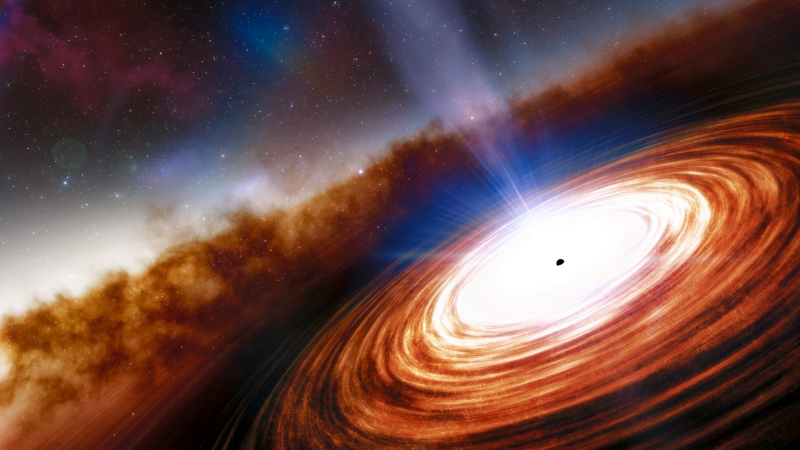
Any really massive black hole will “superheat the material doom-spiraling within their accretion disk to hundreds of thousands of degrees, at which point they emit huge amounts of electromagnetic radiation.”
“The quasars’ immense magnetic fields can sculpt this energy into twin jets that shoot out perpendicularly to accretion disks and extend well beyond their host galaxies.” A Blazar does that, too.
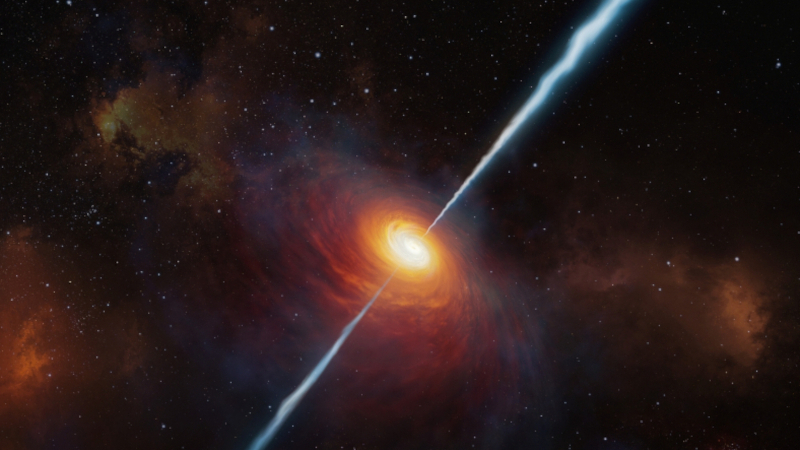
It’s just a quasar where one of the jets points directly in our direction. That creates “radio bright spots that pulse as these black holes consume matter.”
The latest issue of Astrophysical Journal Letters features the discovery of blazar J0410−0139.
A team nailed it down “using data from multiple telescopes, including the Atacama Large Millimeter Array, the Magellan telescopes and the European Southern Observatory’s Very Large Telescope — all located in Chile — and NASA’s Chandra observatory in Earth-orbit.”
12.9 billion light-years
The measurements indicate that radio waves left the surface of the blazar more than 12.9 billion years ago, headed straight in our direction. That’s “a new record for this type of cosmic object.”
The experts are psyched because it’s age “could enable researchers to learn more about how the first supermassive black holes took shape and how these galactic nuclei have evolved ever since.”
According to Emmanuel Momjian, an astronomer at the National Radio Astronomy Observatory in Virginia, “the alignment of J0410−0139’s jet with our line of sight allows astronomers to peer directly into the heart of this cosmic powerhouse.”
Not only that, “this blazar offers a unique laboratory to study the interplay between jets, black holes, and their environments during one of the universe’s most transformative epochs.”
Not only is the object really far away, it comes from only 800 million years after the Big Bang. That’s an instant to cosmologists. It’s at the center of time, or close enough not to matter a whole lot.
“Finding one blazar at this distance hints that many other supermassive black holes existed at this point in cosmic history that either had no jets or beamed their radiation away from Earth.“