



 Mark Megahan

The black hole “bomb” old school physicist Roger Penrose predicted has been created in the lab. It works exactly as expected and doesn’t even require a black hole to produce. Einstein’s ghost approves because “the idea fits perfectly with general relativity.”
Black hole bomb
All the way back in 1969, British physicist Roger Penrose came up with the idea for a really powerful bomb. One that makes nuclear detonations seem like firecrackers.

There’s a way, he pondered, to pull energy from a rotating black hole. On the surface, his idea seems to violate the laws of physics but it’s a violation his lawyers can easily argue his way out of.
Penrose postulated that “that inside the ergosphere — the area just outside a black hole’s event horizon — particles could split.” One chunk falls into the hole and the other gets a kick of “extra energy.”
Einstein’s general relativity explains that “the absorbed fragment’s negative energy actually reduces the black hole’s mass and rotation, allowing the escaping fragment to gain energy without breaking the laws of physics.” It can also produce a bomb.
Belarusian physicist Yakov Zel’dovich started wondering in 1971 “if you could mimic this cosmic trick without needing a real black hole.” He thought that “a rotating metal cylinder could amplify waves in a similar way.”
That’s because “if a wave with angular momentum hit a fast-spinning cylinder, it could get reflected back stronger — stealing a little energy from the cylinder’s rotation.” That isn’t the bomb part.
Add a mirror
Zel’dovich was the one who came up with the idea of surrounding the cylinder with a mirror to “trigger a runaway feedback loop, amplifying small noise into a powerful signal.”
The press soon started talking about the “black hole bomb.” Then, “for decades, no one had been able to confirm it with electromagnetic waves.” That’s changed.
Hendrik Ulbricht and Marion Cromb led a team of researchers at the University of Southampton who “finally achieved what Zel’dovich envisioned.” The rotating system was easy. They used “a simple aluminum cylinder and a three-phase magnetic field.”
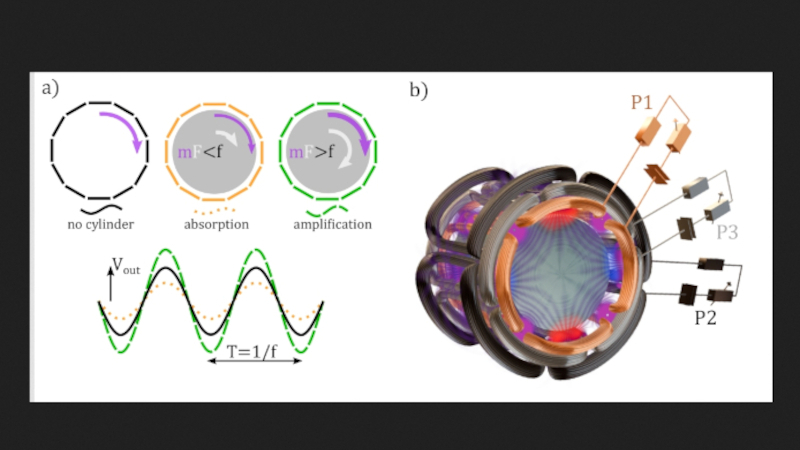
After quickly confirming that the “cylinder’s rotation could amplify electromagnetic waves,” they added the mirror to make it into a bomb.
Physically wrapping a mirror made of glass and reflective backing isn’t practical. They created one electromagnetically with a “resonant circuit.” Then, they sat back quietly and watched as “from only random background noise, electromagnetic waves began to grow stronger and stronger.”
They shut it off before any damage was done but the bomb worked exactly as expected. Not only that, the process “could help detect unknown particles, including candidates for dark matter.“