



 admin
admin

Multiple space and also ground-based telescopes saw one of the brightest gamma ray bursts in space when it reached the Earth on October 9. The burst might be among one of the most effective ever taped by telescopes.
Gamma-ray bursts, or GRBs, are one of the most powerful types of explosion in the universe, according to NASA. Scientists have called this event GRB 221009A, and telescopes around the world are continuing to observe its aftermath.

“The exceptionally long GRB 221009A is the brightest GRB ever recorded and its afterglow is smashing all records at all wavelengths,” said Brendan O’Connor, a doctoral student at the University of Maryland and George Washington University in Washington, DC, in a statement.
“Because this burst is so bright and also nearby, we think this is a once-in-a-century opportunity to address some of the most fundamental questions regarding these explosions, from the formation of black holes to tests of dark matter models.”
Scientists believe the production of the long, intense pulse happened when a large celebrity in the Sagitta constellation– concerning 2.4 billion light-years away– collapsed right into a supernova explosion and also became a great void. The star was likely lot of times the mass of our sun.
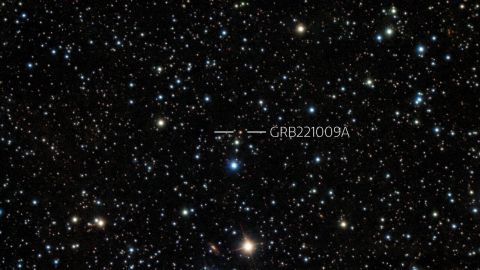
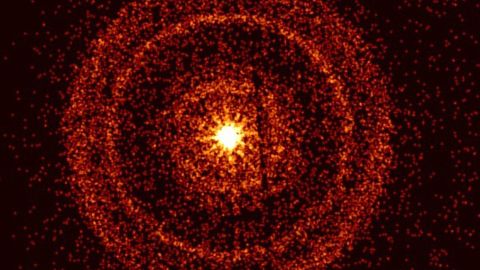
Gamma rays and also X-rays rippled with the solar system as well as triggered detectors installed on NASA’s Fermi Gamma-ray Space Telescope, the Neil Gehrels Swift Observatory, and the Wind spacecraft, in addition to ground-based telescopes like the Gemini South telescope in Chile.
Newborn great voids blow up out powerful jets of bits that can relocate at close to the speed of light, releasing radiation in the form of X-rays as well as gamma rays. Billions of years after traveling across space, the great void’s detonation finally reached our edge of the universe last week.
Examining an occasion like this can reveal more information about the collapse of stars, exactly how matter connects near the rate of light and what conditions might be like in distant galaxies. Astronomers estimate that such a bright gamma-ray burst may not show up again for decades.
The burst’s resource sounds remote, however astronomically talking it’s reasonably near to Planet, which is why it was so brilliant as well as lasted for so long. The Fermi telescope discovered the burst for greater than 10 hours.
O’Connor was the leader of a group making use of the Gemini South telescope in Chile, run by the National Scientific research Foundation’s National Optical-Infrared Astronomy Research Laboratory, or NOIRLab, to observe the after-effects on October 14.
“In our research group, we’ve been referring to this burst as the ‘BOAT’, or Brightest Of All Time, because when you look at the thousands of bursts gamma-ray telescopes have been detecting since the 1990s, this one stands apart,” said Jillian Rastinejad, a doctoral student at Northwestern University in Illinois who led a second team utilizing Gemini South.
Gamma-ray bursts can be triggered by the surge of an extremely enormous star, collapsing into a great void. From the area of the black hole, powerful jets fire in opposite vectors into space, accelerating electrically charged fragments, which in turn interact with magnetic fields and radiation to produce gamma rays.
Astronomers will utilize their observations to examine the signatures of any type of hefty components launched by the star’s collapse.
The luminous burst also gave a possibility for two devices aboard the International Space Station: the NICER (or Neutron star Interior Composition Explorer) X-ray telescope and also Japan’s Monitor of All-sky X-ray Picture, or MAXI. Incorporated, the two devices are called the Orbiting High-energy Screen Alert Network, or OHMAN.
It was the very first time both devices, mounted on the space station in April, were able to collaborate to discover a gamma-ray ruptured, and implied the NICER telescope was able to observe GRB 221009A three hours after it was discovered.
“Future opportunities could result in response times of a few minutes,” claimed Zaven Arzoumanian, NICER scientific research lead at Goddard Space Flight Center in Greenbelt, Maryland, in a statement.
H/T CNN


