



 admin
admin

In the backwoods of Maryland, the legacy of Prohibition moonshiners serving the thirsty markets of Philadelphia and Baltimore and the hypocrisy of Washington, D.C. is still there if you know where to look, especially if you understand what precisely in the blue blazes you’re looking for off in the Catoctin Mountains. What you’ll find there is a painstakingly accurate re-creation of a turn of the century still, a reminder of what was once the largest illegal whiskey distillery in the foothills of Frederick County, MD.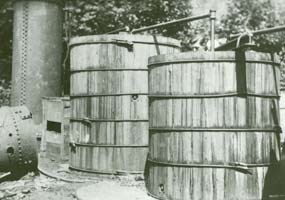
The stills at the blue blazes had already been operating for decades though long prior to January 17, 1920, the day Prohibition turned America dry. This owed mainly to two things: the people of the mountains’ unwillingness to submit to war-time prohibitions during the Civil War and WWI or to the punishing excise taxes that made small-time distilling unprofitable for farmers who needed to move their corn and grain.

According to Atlas Obscura, the enterprise was huge in terms of illegal stills,
“Given the size of the enterprise, the still used the huge boiler from a steam locomotive as a cooker and more than a dozen 500-gallon fermenting vats.”
That’s a respectable operation even by today’s legal standards. At the time the operation was raided in 1929 and shut down, the vats had been upgraded to 2,000-gallon capacity with a thirteenth vat added.
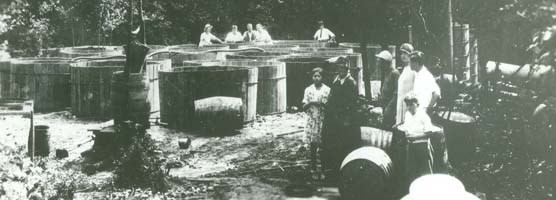
The National Parks Service wrote, “On July 31, 1929, Deputy Sheriff Clyde L. Hauver was fatally wounded in a raid on the Blue Blazes Still. It was a large commercial operation, a “steamer” still. More than 25,000 gallons of mash were found in 13 vats of 2,000-gallon capacity each. Police eventually tracked down several suspects, and two moonshiners were convicted in connection with the murder after several days of conflicting testimony.
Tales of a double-crossing informant, a love triangle, arson, and other rumors spread throughout central Maryland. What exactly happened remains a mystery.”
The Blue Blazes Still Today
Unfortunately, the original MASSIVE distillery was destroyed by Police in 1929, however, the old site sits at a hiking trailhead where a simpler farm-style still has been set up for historic exhibition by the National Parks Service along the Blue Blazes creek for which it is named. It’s a beautiful scenic walk through the lands that once buzzed with the activity of desperate men, seeking their fortune in the forbidden brew of their grandfathers, a man in Washington said they could no longer make.


